



Transforming food presentation with nonwovens
Airlaid nonwovens – based on a process originally developed in Denmark – have found a broad number of applications in the food and beverage industry ranging from absorbent food pads and packaging to thermoformed trays and moulded tableware. The airlaid process emerged from the search for a dry alternative to conventional papermaking – particularly for forming webs containing short pulp fibres – and its initial invention is attributed to Danish inventor Karl Krøyer in the 1960s. By dispersing fibres in an air stream and depositing them onto a perforated moving belt, he opened the path to a dry-forming method that avoided the energy demand and water handling involved in conventional papermaking. During the 1970s and 1980s, companies such as DanWeb and M&J Fibretech refined this early concept, enabling wood pulp to be blended with short synthetic or natural fibres to create bulky, soft and surprisingly strong sheet materials. The resulting webs had a loft and tactile quality well beyond tissue grades, yet their density and strength could be precisely controlled.
Uniformity
Modern airlaid systems build on this foundation with a high level of technical sophistication. Today’s forming heads create exceptionally uniform webs with a balanced CD/MD (cross and machine direction) strength profile at industrial widths and high line speeds. Through-air drying, introduced by the early Danish pioneers, has also matured into a robust technology for wide and complex multi-layer constructions. Manufacturers now combine airlaid with other nonwoven processes to produce substrates that are consistent, stable and readily converted – qualities that have proved essential for applications in which both functionality and appearance matter. Just as importantly, the airlaid process enables the flexible engineering of 100% natural fibre combinations.
Moisture management
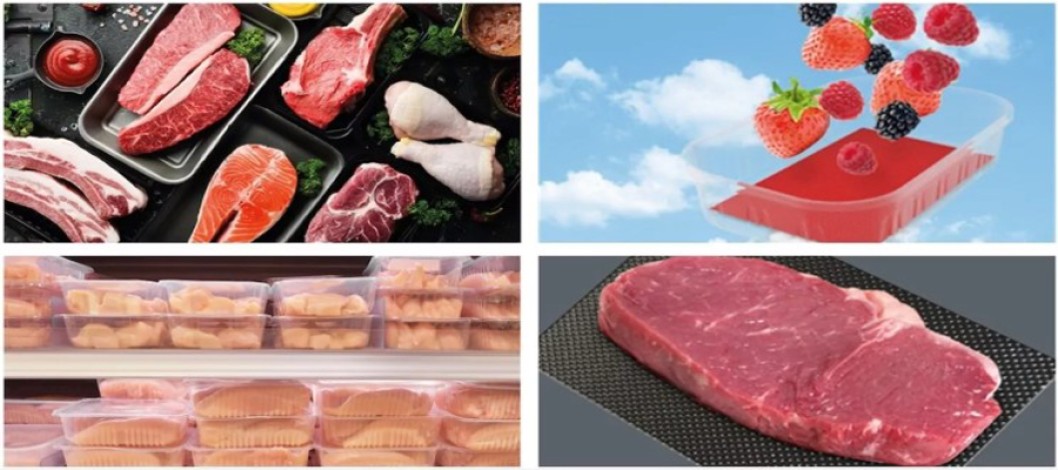
In food packaging, these qualities translate directly into value. Airlaid pads for meat, fish and fresh produce address one of the industry’s most persistent challenges – moisture management. Their highly uniform cellulose structure absorbs and retains excess liquid with remarkable efficiency, preserving freshness while keeping the pack clean and visually appealing. Consumers instinctively equate dryness with quality, and a discreet nonwoven pad plays a central role in maintaining that impression. By preventing pooling, preserving colour and delivering a cleaner opening experience, the material helps reduce waste and extend shelf life at a time when retailers and brand owners are seeking every operational advantage.
Circularity
The purity and natural absorbency of cellulose reinforces these benefits. With high pulp loadings and minimal binder content, airlaid provides a renewable, compostable solution that meets strict regulatory demands for odour neutrality and food contact. It also aligns with the industry’s wider push towards circularity, since these fibre-rich substrates reduce plastic use and can incorporate recycled or alternative pulps.
At INDEX™26, leading suppliers of cellulose pulp feedstocks, including the Finnish producers Stora Enso and UPM Raumacell and the US companies GP Cellulose and Global Cellulose Fibers, will highlight the breadth of chemistry now shaping the next generation of absorbent solutions.
Exhibitors such as Germany’s McAirlaid’s and Magic S.P.A. of Italy will meanwhile show how far the technology has progressed through process ingenuity and materials science. McAirlaid’s SuperCore, produced entirely without adhesives or latex, creates a pure cellulose matrix with outstanding absorption capacity while remaining thin, stable and safe for direct food contact. Its MeatGuard range illustrates how a well-designed pad can lift the overall presentation of meat and fish, locking in drip, maintaining surface dryness and ensuring the product reaches the consumer in an appealing state.
Magic takes a complementary approach with Spongel, its biodegradable superabsorbent powder integrated directly into airlaid webs. This chemistry enables fully compostable food pads, such as the G-pad, that can be disposed of alongside organic waste without compromising performance.
Versatility
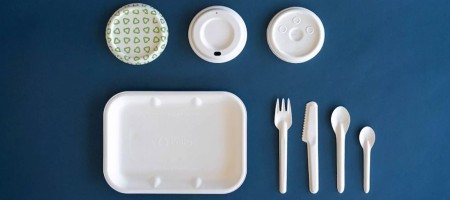
Beyond absorption, airlaid’s structural versatility is now creating new opportunities in thermoformed packaging. By adjusting basis weight, density and layer construction, producers can form rigid or semi-rigid shapes suitable for trays, lids and inserts used for bakery goods, fresh produce and ready meals. These fibre-based components offer a renewable alternative to plastic yet retain the stiffness and dimensional stability needed for automated filling and sealing lines. In premium food and beverage packaging, airlaid substrates deliver effective cushioning, wicking and condensation control, making them ideal as interleaves or protective wraps for glassware, bottled items or delicate confectionery.
A growing number of system suppliers have expanded the technological frontier and among them, Andritz, another INDEX™26 exhibitor, now provides complete airlaid lines following its acquisition of Dan-Web. Andritz brings defibration, web forming and drying into a cohesive full-line offering for manufacturers seeking consistent, wide-width capability at scale.
Convergence
The momentum behind airlaid reflects a broader shift in packaging strategy. Brand owners are searching for materials that combine renewable content, low water demand and the capacity to integrate recycled or waste fibres while meeting exacting standards of purity, safety and converting efficiency. Airlaid’s dry-forming origins have positioned it uniquely to respond to these pressures, and the recent surge in fibre-based tray and pad solutions shows how quickly the market is adapting.
INDEX™26 in Geneva will showcase this convergence of materials science, processing know-how and sustainability. The rise of airlaid materials in food and beverage applications captures the essence of what the nonwovens sector now delivers – smarter, cleaner and more resource-efficient solutions that elevate everyday products while supporting a more circular future.
You can learn about South Asia's
largest exhibition on this topic through this link: https://nonwovenexpo.com/
Source: Online/NAN



Comment Now